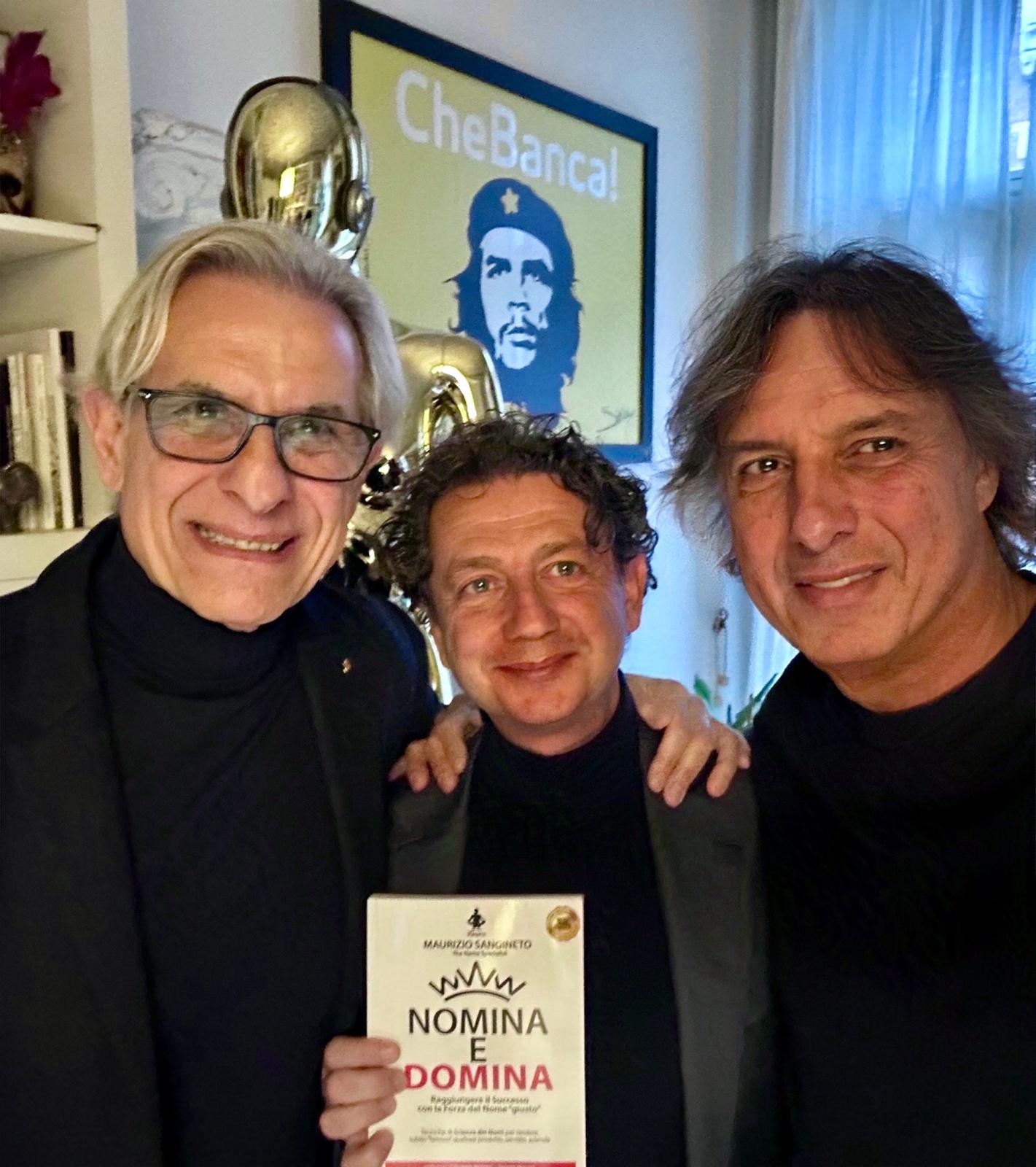
Three men named Maurizio together, and one of them is a specialist in names. Looking back at the photographs, the coincidence still makes me smile.
On 6 November, in Vicenza, I met with Maurizio Sangineto and Maurizio Insana. Sangineto also had his artist name, Sangy, to fall back on. The other two of us had our surnames, or our stories to tell.
Maurizio Insana and I have been friends for many years. I was glad to share this occasion with him too. In the photographs, I see the familiarity that grows over time and makes being close feel natural. Genetics, epigenetics and nutrition are some of the fields within a broader professional journey, which I have also had the pleasure of getting to know through our conversations.
Sangy welcomed us into his world. He is a multidisciplinary artist and a specialist in naming and domain naming. He works with the words through which businesses, products and projects introduce themselves to others, and the names that make them recognisable online too.
He gave us Nomina e Domina. In the close-up photograph, the three of us are together and I am holding the book in front of me. I like this image because it preserves something of the welcome we received. The book becomes part of my memory of the day through the gesture of the person who gave it to us.
The meeting was made possible by Relazionésimo and its founders, Ketty Panni and Ombretta Zulian. I owe them this opportunity to get to know Sangy’s world better and to share that time with Maurizio. The relationship had a very concrete outcome: it allowed us to be there and to talk.
Thinking about the title of the book brings me back to a question that accompanies my work in Scent Identity Design: when a scent makes us recognise something, how do we find the words to describe it?
A fragrance can feel familiar even when we struggle to say what it reminds us of. A place may come to mind, or the memory of a person, before all the details are available. We search for a word and sometimes the one we find seems only close.
I can describe a smell as sweet, dry or fresh. These are useful words to begin with. But if I want to explain why that scent means something to me, I need to keep looking. This is the passage that interests me: from describing what I smell to recognising something that belongs to my own experience.
A name can take us in the opposite direction. We encounter the word first and begin to imagine from there. Its sound, its meaning and the associations that come to mind all contribute to what we expect to find.
I think, for example, of a name that evokes the sea. One person might imagine a beach in summer, another a harbour in winter. I am curious about the distance between these images: both possible, both connected to a word that seemed precise enough.
Considering Sangy’s work alongside my own makes me pause over this distance. When I choose a word to accompany an olfactory experience, I am already suggesting a way of approaching the scent. I want to be aware of how much that choice may help someone express themselves, and how much it may suggest an answer.
In my work in Scent Identity Design, this also means paying attention to when I step in. I can allow the person smelling a scent to search for an association, try to describe it and revise their wording. I can then offer my own words and check whether they fit what that person is trying to say.
I want language to retain something of the person using it. An elegant or technically precise word may be less fitting than a simple expression, perhaps connected to a memory I only learn about by listening. This, too, can be where a project begins to take a personal direction.
From Vicenza, I keep the photographs, the book and the pleasure of the meeting. The coincidence of our three names still amuses me. But it also leaves me with a question about how I work: does the word I am choosing help the person in front of me recognise themselves, or does it mainly tell them how I see things?